Lifestyle
Moon Jars in a New Light: Laurin Schaub for Homo Faber.
Meet the artist creating glow-in-the-dark moon jars with IWC's Ceralume® for the Homo Faber Biennial 2026.
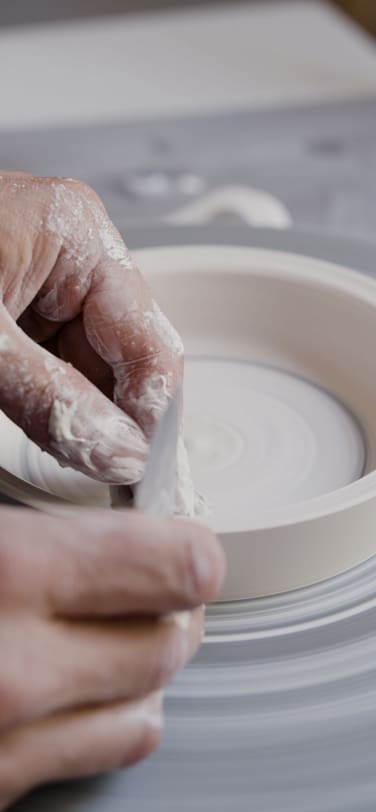
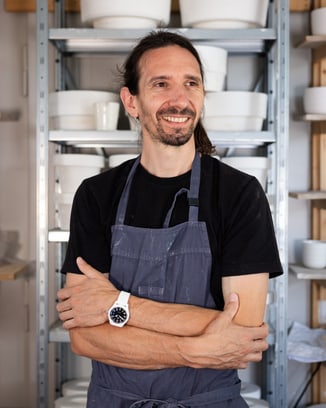
Laurin Schaub works to the rhythm of passing trains. Their steady, recurring sound forms a kind of creative pulse: measured, constant, and deeply familiar. It’s no coincidence, then, that he chose an old train station as the home of his pottery workshop, where trains roll by every 15 minutes like clockwork. He, however, is not going anywhere. He is the constant, working to the rhythm of trains – and people – coming and going.
The renowned Swiss ceramic artist has treasured this sense of constancy since his days as a young apprentice, throwing pots on the wheel day in and day out. But for him, pottery was always more than repetition. It became a way to reflect, to slow down and find his own pace. An approach that ultimately earned him a Swiss Design Award in 2018 and the Prix FEMS (Fondation Edouard et Maurice Sandoz) in 2022.
Today, Schaub is featured in the Homo Faber Guide, the online platform celebrating Europe’s master artisans and their craftsmanship. His work has been exhibited in the Museum of Design Zurich and the Musée Ariana in Geneva, while several of his pieces have entered the collection of the French State.
Schaub’s latest works – two luminescent Moon Jars with a bespoke glaze inspired by IWC Schaffhausen’s patented Ceralume® luminous ceramic technology – are currently on display at the fourth edition of the Homo Faber Biennial in the historic grounds of Fondazione Giorgio Cini.
In a conversation with the IWC Journal, Laurin reflects on the creative process behind his work, and reveals how light, the horizon and the unique setting of his workshop continue to shape his craft.
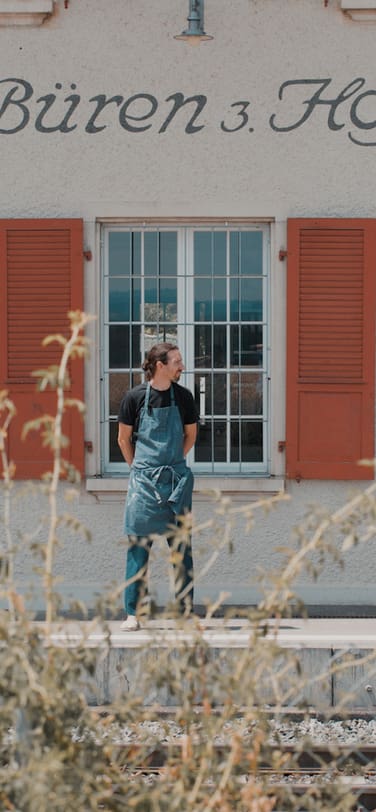
Light playing, trains painting.
What brought you to this specific location, and how does your environment here influence your work and daily life?
I came here to Büren zum Hof because I wanted to live on the countryside. [..] I really enjoy this – this old train station – because there's light from almost every side. It's a very luminous space. And it has this romantic character of a train station – which is very beautiful.
What about the noise of the trains? Are you not bothered by it?
I don't hear them anymore. Sometimes it's nice, because the trains are orange, so if they pass by or stop on Track 1 – the whole atelier is going to be colored in orange because the white walls are reflecting the orange from the trains. I think these are nice effects, aesthetic effects ... it's a rhythm through my daily life.
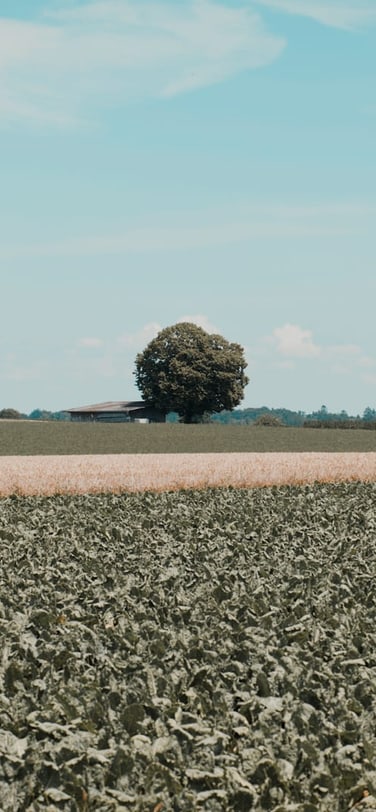
The Wabi-Sabi of Pottery.
What do you enjoy most when working in this location?
In here, I really love to look out of the window – it's a flat landscape and you can see to the horizon. It's a relaxing landscape. There's not much that is disturbing around here. It's very green. It's a healthy environment for me to work in.
Where do you find your inspiration?
I'm inspired by architecture. My work is sometimes related to architecture or design, which is something a contrast to the pottery. I'm inspired by things that are not nature-like or intuitive. Because pottery is always – it has this aspect of intuition, of wabi-sabi – it's the irregularities, the handmade. So I'm often inspired by the opposite, and I like to contrast pottery with some straight lines. […]
More and more, I love to go to museums and see these ancient works – this is one side that connects me to the tradition and also to humankind. That is one source of inspiration that is very important.
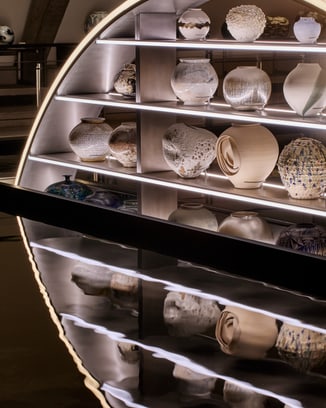
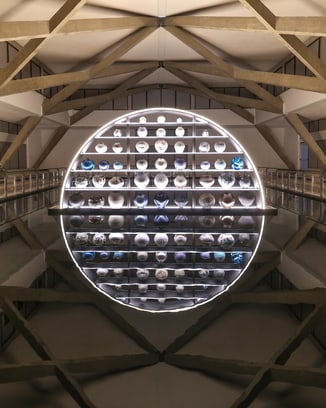
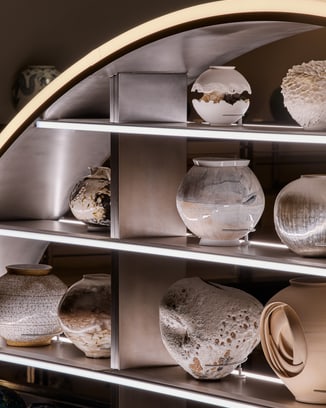
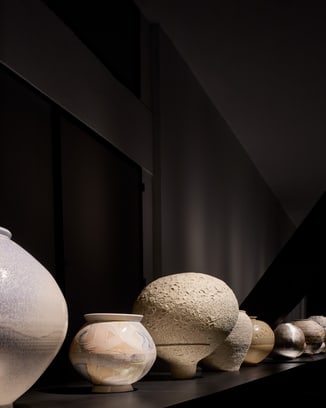
All images by Alessandra Chemollo©Michelangelo Foundation
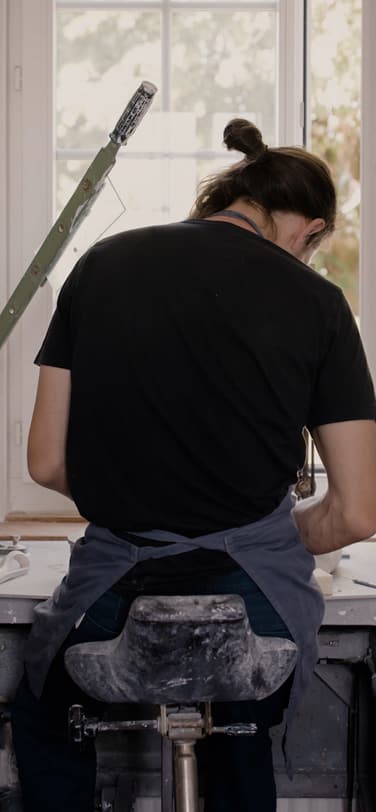
Connection to ancestors.
How do you maintain your creative flow? Are there rituals or practices that help you connect with your artistic self?
My work is always a creative process. And for creative processes, you need space and time. To make mistakes. To start again. […] I need an open space to work. If I have this – that would be a perfect situation. But daily life is mostly imperfect. […] Making ceramics – you have to follow the material. Every step takes time. I cannot teach the material what to do, but I can follow the material, and by using the material's own aspects to develop something new.
The moon jar form carries centuries of history. When you create these pieces, do you feel a connection to the artisans of the past?
I always feel connected through pottery to the ancestors.
The moon jars are an interesting topic. Because there's a huge history behind them, and it's also fun because it's now something hip. For me, it's interesting to follow this topic and to find my own interpretation.
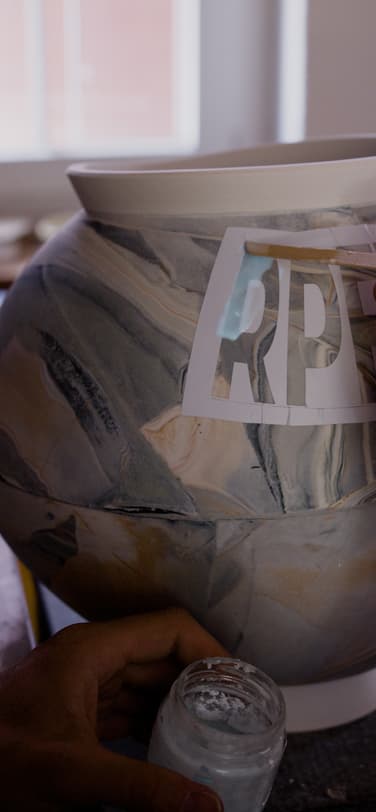
Making of a Ceralume® Moon Jar.
Could you describe the different stages of crafting these moon jars?
Once I have a mold in plaster, I start to produce the piece in clay. Step two is to color the clay. I use a [Japanese] technique called 'Nerikomi'. I take some white porcelain and add some ceramic pigments. Once I have a selection of different colors I want to use, the next step is to combine these colors, little pieces of each color, putting them close to each other on a textile – and then rolling it out […].
Once I have a slab of this colored clay, I cut the slab, putting the two pieces on top of each other – and rolling it out again. Until the different layers of colored clay become a pattern – which is close to stone, to marble, or to a surface of the moon, [with an] aesthetic of planets.
How does Ceralume® transform the traditional ceramic process and the final aesthetic of the moon jar?
The moon jar will have two states. One is this moon-like, marbled surface. The other state is at night – then a pattern is appearing. […] It's very time-consuming to apply the photoluminescent glaze on the vessel and it's a very precious material. […]
I really love challenges with ceramic materials, and I've never worked with a material like Ceralume® before. And I really loved having this opportunity to work with a material that is absolutely uncommon.
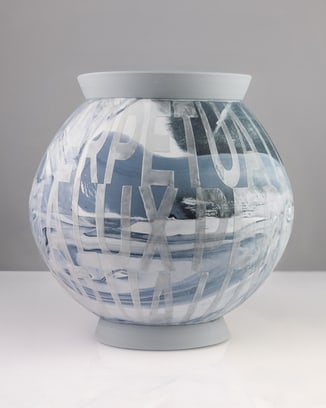
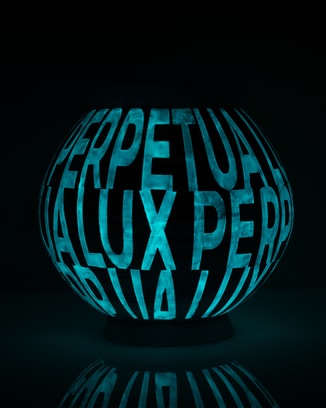
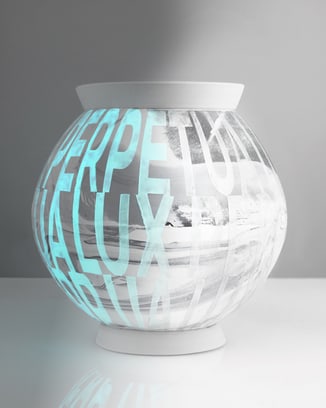
Addendum
This year’s edition of Homo Faber Biennal in Venice, a world-renowned celebration of human craftsmanship, is themed “An Island of Light” and explores the interplay of light, material, and human artistry. Laurin Schaub’s Moon Jars, inspired by 18th-century Korean spherical porcelain vessels, are a highlight of IWC Schaffhausen’s installation “A Full Moon Rising,” one of 15 immersive exhibits showcasing over 800 objects by artists from more than 70 countries. Central to the display, an illuminated semicircular structure, reflected in the still water of the indoor swimming pool “Piscina Gandini” from 1961, forms a complete circle – a full moon brimming with moon jars. Developed by Schaub through countless tests, the bespoke luminous glaze reveals the inscription “Lux Perpetua” (Latin for “Perpetual Light”), a direct reference to IWC’s legacy of perpetual calendar complications and its proprietary Ceralume® technology. Two moon jars will be displayed at Piscina Gandini, the third in IWC’s Venice Boutique.
FAQ
What is Ceralume®?
Developed by IWC Schaffhausen’s engineering division XPL and first introduced in 2024 as a fully luminous ceramic concept Pilot’s Watch Chronograph 41, Ceralume® is a bluish luminescent ceramic engineered to store and emit light for over 24 hours. This light absorption and emission cycle can be repeated infinitely without capacity loss.
Which IWC timepieces are made of Ceralume®?
IWC first showcased Ceralume® in 2024 as a fully luminous ceramic concept Pilot’s Watch Chronograph 41, with a luminescent dial and Super-LumiNova®-enriched rubber strap. Serial production began in 2026 with the Big Pilot’s Watch Perpetual Calendar Ceralume® (Ref. IW505801) featuring a 46.5mm luminous white ceramic case and the IWC-manufactured 52616 caliber. In daylight, it presents varying shades of white and gray with shiny and matte surfaces, while in darkness, the case, dial and strap emit an intense bluish glow.
How is Ceralume® produced?
Ceralume® is produced by mixing ceramic powders (zirconium and other metallic oxides) with high-grade Super-LumiNova® pigments, a high-tech ceramic compound from Swiss technology company RC Tritec. IWC’s engineering division XPL developed a dedicated ball milling process for a homogenous mix, with sintering and grinding processes also specifically adapted for this luminous ceramic.
What role do ceramic watches play in IWC’s portfolio?
Showcasing four decades of expertise in advanced materials since pioneering hard, scratch-resistant ceramics in 1986, IWC has continuously enhanced its ceramic technology, introducing significant developments like composite watch cases, including proprietary Ceralume® and Ceratanium®, which unites the lightness and strength of titanium with a hardness and scratch resistance comparable to ceramic.
